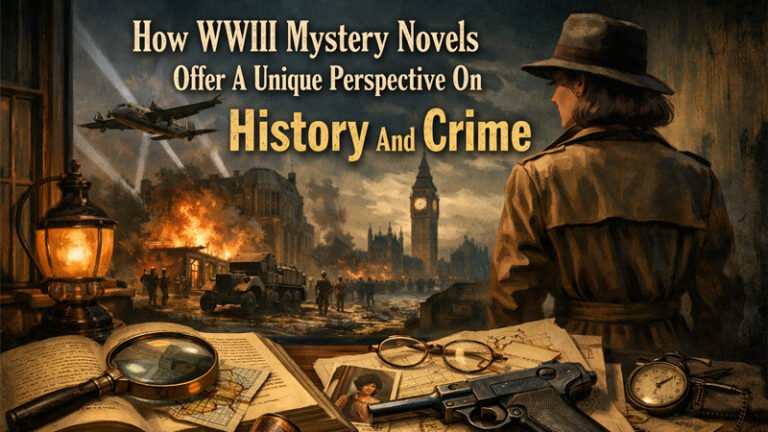
History books tell us what happened during World War II—but mystery novels show us how it felt. That’s where WWII mystery novels truly shine. They place readers inside bombed-out cities, shadowy resistance networks, and morally complex choices where right and wrong aren’t always clear. Instead of dates and battle maps, we follow clues, secrets, and crimes shaped by wartime fear and survival.
If you’ve ever wondered why so many readers search for WWII mystery novels to read, the answer is simple: these stories combine real historical tension with page-turning suspense. They make the past personal, emotional, and unforgettable—like stepping into a dimly lit room where history whispers instead of lectures.
WWII As The Perfect Backdrop For Mystery
World War II was a time of secrets—coded messages, hidden identities, and underground movements. That alone makes it an ideal setting for mystery fiction. Every street corner feels suspicious, and every conversation could carry danger.
Unlike modern crime stories filled with technology, WWII mysteries rely on instinct, human error, and courage. There are no instant databases or security cameras—just intuition and risk. It’s like trying to solve a puzzle while the table itself keeps shaking.
This unstable environment naturally raises the stakes, turning even small crimes into life-or-death situations.
Crime In A World Without Clear Rules
War changes everything, especially morality. In WWII mystery novels, crimes don’t always look the same as they do in peacetime. Is stealing food a crime—or survival? Is lying treason—or resistance?
These stories force readers to question justice itself. Investigators aren’t just solving murders; they’re navigating chaos. The legal system is often broken or controlled by occupying forces, which adds tension and moral conflict to every decision.
This blurred line between right and wrong gives WWII mysteries a realism that feels raw and honest.
Ordinary People Turned Investigators
One of the most compelling aspects of WWII mystery novels is that the heroes are rarely professional detectives. They’re teachers, nurses, refugees, soldiers, or civilians caught in extraordinary circumstances.
Why does this matter? Because it makes the story more relatable. These characters investigate not because it’s their job, but because they must. Curiosity becomes courage, and survival demands truth.
Watching ordinary people rise under pressure feels like witnessing history through human eyes—not heroic legends, but real individuals making impossible choices.
Emotional Depth Beyond Traditional Mysteries
Traditional mystery novels focus on who did it. WWII mysteries ask something deeper: what did it cost?
Loss, trauma, love, and guilt are woven into every clue. A missing person isn’t just a case—it’s a family torn apart by war. A murder isn’t isolated—it echoes through communities already broken by conflict.
Think of these novels as emotional time capsules. They don’t just reveal answers; they reveal scars.
The Rise Of Thriller Romance Cross-Genre Books
In recent years, readers have embraced thriller romance cross-genre books, especially within WWII settings. Why? Because war heightens emotion. Love feels urgent. Trust becomes dangerous. Romance isn’t soft—it’s risky.
When mystery, thriller, and romance blend together, the result is powerful. A glance can be suspicious. A relationship can become a liability. Love itself becomes part of the mystery.
These cross-genre stories appeal to readers who want suspense and heart—danger mixed with desire.
Fiction That Encourages Historical Curiosity
One of the hidden strengths of WWII mystery novels is how they inspire learning without pressure. Readers often finish a novel and think, Did that really happen?
That curiosity leads to research, documentaries, and deeper understanding. In this way, fiction acts as a doorway into real history—gentle, engaging, and memorable.
For readers searching for meaningful WWII mystery novels to read, stories like Searching for Noriko offer this blend of historical authenticity and narrative tension.
Luna del Lobo And A Fresh Narrative Voice
What sets Luna del Lobo apart in this genre is the emotional intelligence behind the storytelling. Instead of focusing only on action or crime, the narrative explores identity, displacement, and memory.
The mysteries unfold slowly, allowing readers to absorb the atmosphere and emotional weight of wartime life. It’s not just about solving a puzzle—it’s about understanding people shaped by history.
This thoughtful approach makes Luna del Lobo’s work stand out for readers who crave depth, not just suspense.
Conclusion
WWII mystery novels do more than entertain—they invite us to experience history through tension, emotion, and human struggle. By blending crime with real historical stakes, these stories transform the past into something vivid and personal.
Whether you’re drawn to moral dilemmas, emotional storytelling, or thriller romance cross-genre books, WWII mysteries offer something rare: insight wrapped in suspense. And through voices like Luna del Lobo, readers gain a powerful reminder that history isn’t just what happened—it’s what people endured.
If you’re looking for stories that challenge, move, and captivate, WWII mystery novels might just be the most compelling way to look back.